
Questions and answers about working with Weinstein Realty Consultants as your property tax consultant for commercial properties throughout Pennsylvania, Delaware, Maryland, New Jersey, New York, Ohio, and Virginia.
By researching your property and reviewing your property tax bill, assessment notice, and other pertinent data. If it is determined that an appeal is warranted (recognizing that not all properties are over-assessed), we will meet with you to discuss the merits of a formal tax assessment appeal. Because each of the states we serve has its own assessing authority, appeal body, and filing calendar, we tailor this review to the specific jurisdiction where your property is located.
It depends on the state and county. Some jurisdictions resolve appeals at the administrative level within a few months; others move into a second or third level of review, which can extend the timeline into the following year. See the state-by-state summary below for the general appeal path in each jurisdiction we serve.
Although most tax assessment appeal cases need to be litigated procedurally to preserve the taxpayer's rights, the probability of actually proceeding through a full court hearing is very minimal. Litigation becomes a necessary part of the tax appeal process in order to properly posture the negotiations.
The reality of tax assessment appeals is that the stronger the merits of the appeal, the more likely it may be pursued to a higher level of review. If a substantial reduction is in order, the effect of that reduction is reduced revenue for the county, school district, and municipality. In several of the states we serve, school districts or other taxing bodies have the legal right to intervene in — or in some cases independently challenge — real estate tax assessment appeals, since they are often the largest recipient of real estate taxes.
This varies by state:
● Pennsylvania: No. Real estate assessment law only permits appeals to be effective for the subsequent year. There is no legal right to appeal past or current real estate assessments — except where the appeal was filed timely, and litigation carries into a following year, in which case relief can be made retroactive to January 1 of the year the appeal was filed.
● New Jersey: Appeals apply to the current tax year in which they are filed.
● New York, Maryland, Ohio, Virginia, Delaware: Appeals generally apply to the assessment year being challenged (i.e., the current roll or notice), not to prior years. Some states allow limited retroactive correction for specific administrative or clerical errors.
We'll walk you through the retroactivity rules that apply to your specific property and state.
This also depends on the state and, in several cases, the county. Generally, a reduction from an administrative-level decision (the first level of appeal) is reflected in the next tax bill issued after the decision. A reduction won through litigation, if the case carries into a subsequent year, is often made retroactive to the year the appeal was originally filed — but the specific mechanics vary by jurisdiction. We'll confirm the applicable rule for your property at the time of filing.
State-by-State Appeal Process Summary*:
The seven states we serve each administer property tax assessment appeals differently — different assessing bodies, different filing windows, and different appeal levels. The table below is a general reference; exact deadlines are set at the county or municipal level in most of these states and can shift from year to year, so we confirm the current filing window for your specific property and jurisdiction before every filing season.
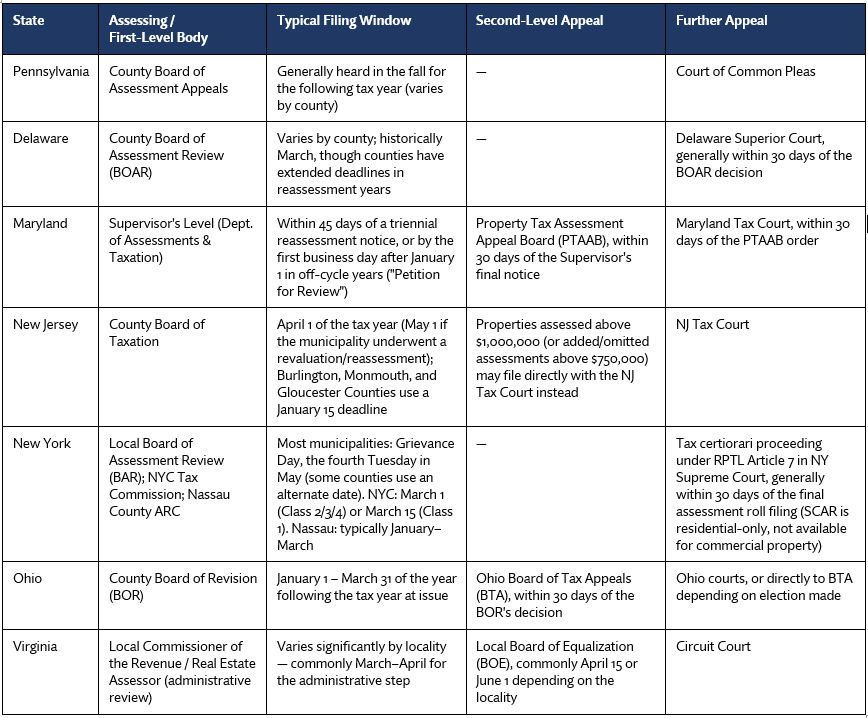
*Dates above reflect the general/typical pattern described by state agencies and county offices as of August 2026
Don't see your state listed above? Contact us — we regularly evaluate new markets and may already have the expertise to help with your property.
Each state has its own escalation path, evidentiary standards, and court system:
● Pennsylvania appeals that aren't resolved at the county Board of Assessment Appeals proceed to the county's Court of Common Pleas, where the case is heard de novo (the court considers the evidence fresh, rather than simply reviewing the Board's record). School districts have standing to intervene in these appeals, since they receive the largest share of the resulting tax revenue.
● Delaware has historically reassessed properties infrequently, so appeals there often turn on relative equity with comparable properties rather than a fresh reassessment.
● Maryland uses a three-step process — Supervisor's Level, the Property Tax Assessment Appeal Board (PTAAB), and the Maryland Tax Court — and the property owner carries the burden of proof by "clear and convincing evidence" at the PTAAB level.
● New Jersey allows properties above certain assessed-value thresholds to bypass the County Board of Taxation and file directly with the State Tax Court.
● New York requires a commercial property owner to first grieve at the local Board of Assessment Review (or NYC Tax Commission, or Nassau's ARC) before pursuing a formal Article 7 tax certiorari proceeding in State Supreme Court.
● Ohio allows school districts to file counter-complaints seeking to increase a valuation, which is a consideration worth discussing with your consultant.
● Virginia Boards of Equalization have the authority to raise, lower, or leave an assessment unchanged when reviewing an appeal — not just grant reductions.
We manage these differences on your behalf and will always explain the specific process, standard of proof, and realistic timeline for your property's jurisdiction before recommending an appeal.
We hope these questions and answers outline the benefit of having Weinstein Realty Consultants as your tax assessment appeal consultant across Pennsylvania, Delaware, Maryland, New Jersey, New York, Ohio, and Virginia. We look forward to assisting your company in achieving an equitable real estate assessment and the resulting effective real estate taxes for your property.
Copyright 2026 - Weinstein Realty Consultants - All Rights Reserved.
Site Design and Hosted by
Sunken Treasure Design